INTERVIEW - CARLOS PEREZ ROMERO
THE ISLAND OF THE GIANT MOTHERS won the Best Documentary award in our LCF’s 3rd Edition.
Interview with director Carlos Pérez Romero.
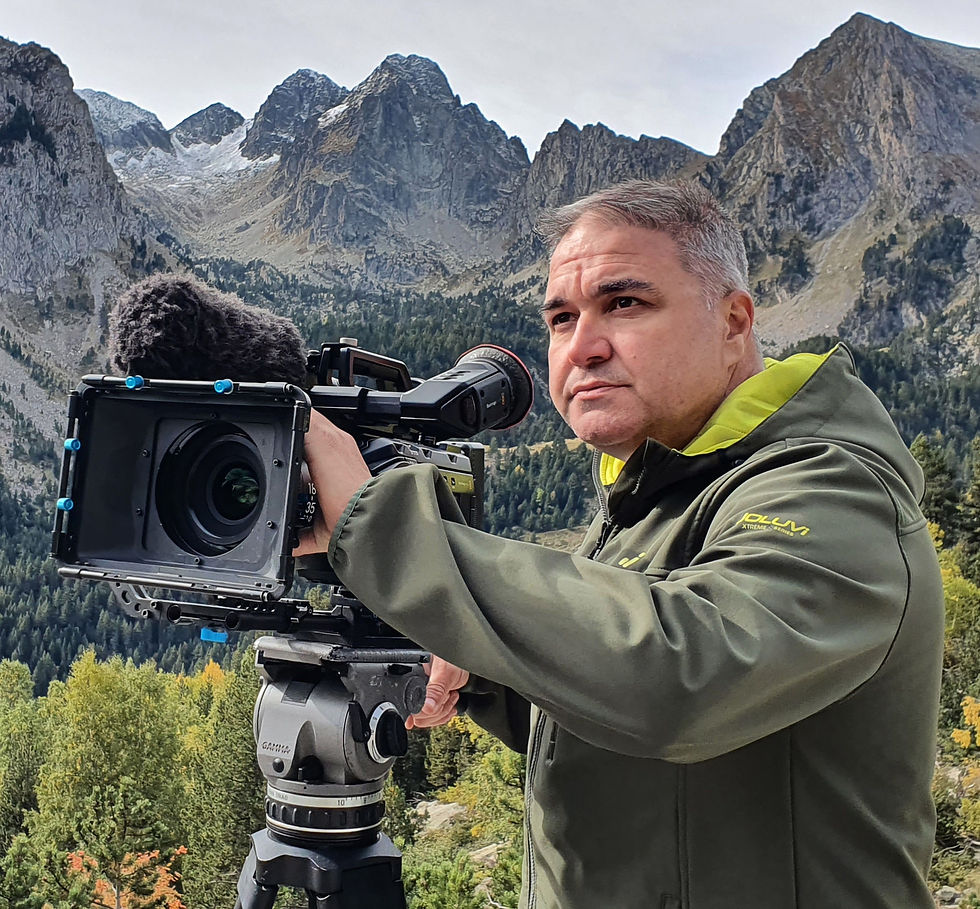
What got you into making documentary films, and have you always worked in this kind of productions?
I grew up very close to nature and from an early age I knew I wanted to tell real stories. I was strongly influenced by El hombre y la tierra by Félix Rodríguez de la Fuente, which made me understand that nature could be filmed with emotion, respect, and narrative depth.
I started working in audiovisual production and television, but in 2014 I made my first nature documentary with almost no budget. That project unexpectedly began to sell internationally and changed everything. From that moment on, I focused entirely on documentary filmmaking.
Yes, I have always worked in documentaries, mainly wildlife and nature films. I learned by doing: long days in the field, mistakes, patience, and observation. That process shaped both my style as a director and the identity of 1080 Wildlife Productions.
What was the starting point of launching THE ISLAND OF THE GIANT MOTHERS?
The project started during a trip to Guinea-Bissau, when we spent a night on Poilão Island, the second most important nesting site in the world for green sea turtles. Experiencing that place for the first time is what sparked the idea.
Three years later, we organized the expedition. We had to be completely self-sufficient: bringing large amounts of water, hiring a cook, and generating electricity using batteries and solar panels. We lived isolated for more than a week, over three hours away from the nearest inhabited place.
The shoot was physically demanding due to the climate—extreme heat, as we were in the tropics—but the nights were extraordinary. Hundreds of green turtles came ashore to nest, while hundreds of hatchlings emerged and made their way to the sea. Those days were unforgettable, and that experience is the reason we are so proud of the final result of the documentary.
Wildlife documentaries are a genre in itself. As a director, how do you prepare for such a task?
I prepared both mentally and physically. From experience, I knew the expedition would mean working without breaks, long days and nights in extreme conditions, so the mental preparation started days before arriving on the island. Being focused and calm is essential when you know there will be no comfort and no margin for error.
Physically, I prepared to endure daily, continuous work with almost no rest. On Poilão Island we worked every day, adapting to the rhythm of the turtles and the climate. There were no fixed schedules—only the natural cycles—so resistance and discipline were key. That combination of mental strength and physical endurance is something I’ve learned over the years making wildlife documentaries in remote places.

When was THE ISLAND OF THE GIANT MOTHERS shot? What were the shooting days like? How many of them did you have in the end?
The film required more than a year of pre-production, mainly for logistics, permits, and planning the team and equipment. The actual shooting took place over more than a month in Guinea-Bissau.
Because of the extreme logistics, it was impossible to stay on Poilão Island for more than a week at a time. We worked in alternating periods: our base was on the larger island, staying at Orango Parque Hotel, and from there we travelled to Poilão with all the equipment every other week.
In total, we spent over a month in Africa and more than ten shooting days on Poilão Island, spread across several visits. The shooting days were long and intense, completely dictated by the turtles’ activity and the natural conditions, with no real rest and very demanding physical work.
For a 52-minute format like this, how many hours of rushes do you bring back as a raw material?
It requires very strict planning. Every day all the footage had to be backed up, so we worked with 40 terabytes duplicated — 80 terabytes in total. Each day we copied the material to two separate hard drives, so if one failed or was lost, we had a full backup.
In the end, we brought back around 32 terabytes of 4K material, which is approximately 30 hours of rushes. That is a large amount of footage for a 52-minute film, and it meant a very careful and demanding selection process during editing.
Was there an animal or a sequence in particular that will stay with you from this shooting?
Without any doubt, the hatching moments are the strongest memories. Watching the baby turtles emerge from the sand and run toward the sea is a unique and unforgettable experience.
Another moment that stayed with me was when the whole team rescued an adult turtle that became trapped between rocks after nesting, on a very stony beach. The tide was going out and she was already dehydrating. If we hadn’t intervened, she would not have survived. That moment deeply marked us as a team and reflects the responsibility that comes with filming wildlife in such extreme conditions.
Do talk about the postprod!
Post-production took around eight months of very intense editing. It meant long daily sessions in front of the computer to shape the story exactly the way we wanted. When you start with more than 30 hours of footage for a 52-minute film, the beginning is always the most difficult part.
Little by little, sequences start to close, the narrative finds its rhythm, and the film takes shape. We also dedicated a lot of time to the original soundtrack, which was a key element in the emotional construction of the documentary.
We are very happy with the final result, and the response has been extremely positive. The film has been well received by many broadcasters and festivals, and we are fortunate that it is now being shown all over the world.
Where can people watch your documentaries? (this one or some others)
During the first two years after release, our documentaries are broadcast on public TV channels around the world, including WDR, ARTE, RTVE, RAI, RTP, CCTV, and ARD, among others.
They are also available on many platforms such as Prime Video, Apple TV, Samsung TV, and ROKU. There are many outlets where the films can be seen; usually, searching the title of each documentary is enough to find the channels or platforms where it is available.
We announce broadcasts and releases on our social media, and all the updated information can also be found on our website: www.1080web.es.

Any future projects you would like to mention?
Looking ahead, we continue to explore destinations around the world for our documentaries, a process we carry out discreetly until we can bring it to the screen. This year, we are releasing productions filmed in Norway and the Amazon, and over the next two years, we have planned shoots in Africa and Asia, as well as several documentaries in Spain that are currently in development.


Comments